If you're a Registered Massage Therapist (RMT) in British Columbia, you may be wondering whether you need to charge GST on your treatments.
Maybe you've just started practising, you're approaching $30,000 in revenue, or you're working at a clinic on a 60/40 or 70/30 split.
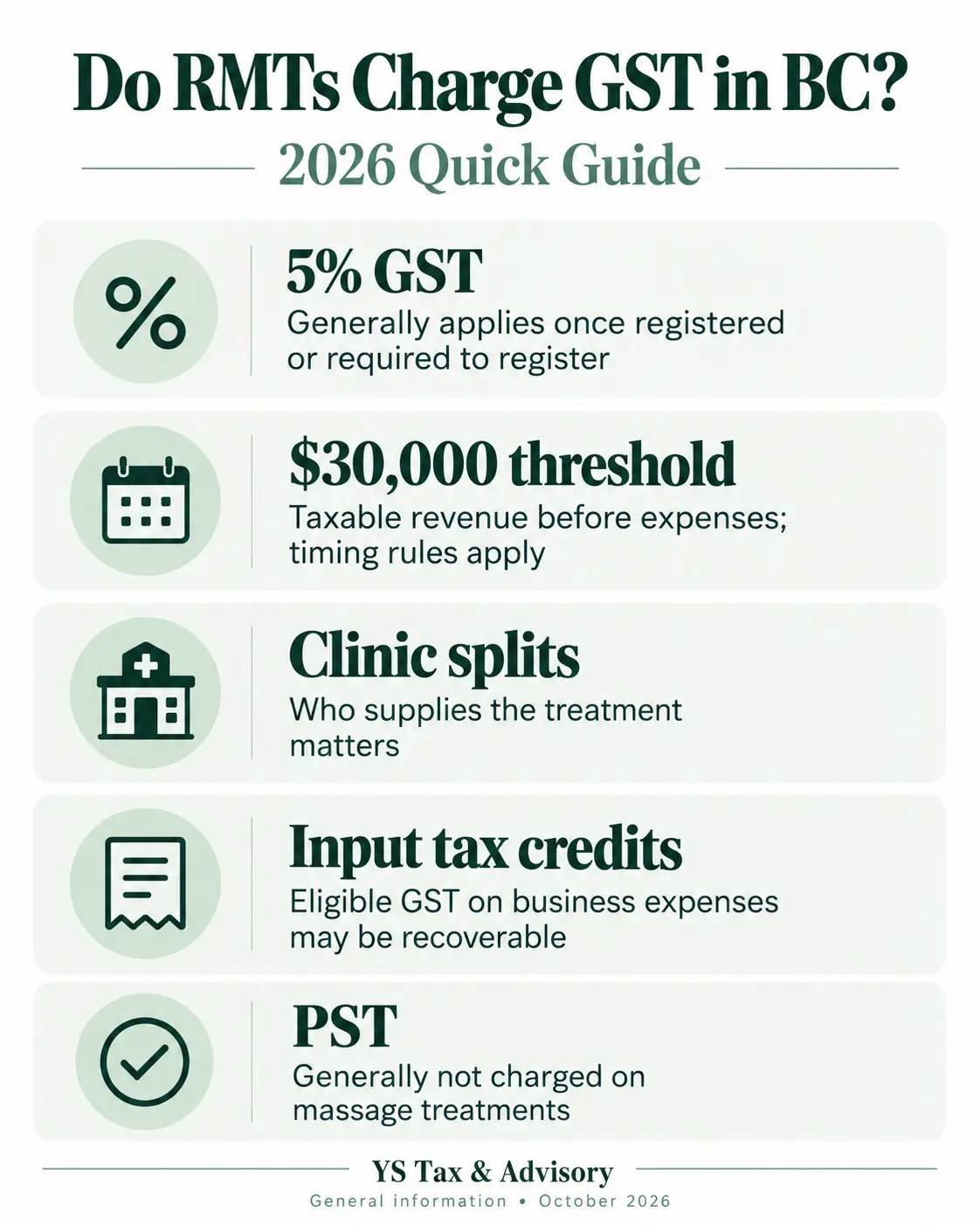
The short answer: Yes. RMT services in BC are generally subject to 5% GST once you're registered or required to register. However, if you're an unregistered small supplier, you generally don't need to charge GST yet.
Here's what you need to know about registration, clinic splits, business expenses and filing deadlines.
1. Why do RMTs charge GST when physiotherapists don't?
Although massage therapy is a regulated health profession in BC, it isn't on the federal list of exempt practitioner services.
For example, qualifying physiotherapy, chiropractic and acupuncture treatments can be GST exempt.
Massage therapy generally remains taxable, even when provided by a Registered Massage Therapist for a medical condition.
Example: A client books a $120 treatment and you're registered for GST.
| Description | Amount |
|---|---|
| Massage treatment | $120 |
| GST (5%) | $6 |
| Total charged to client | $126 |
The $6 collected is GST, not additional business revenue.
The CRA also confirms that separately provided massage therapy services are generally taxable unless another exemption applies.
2. When does an RMT need to register for GST?
Keep track of what clients pay you in three-month blocks: January–March, April–June, July–September and October–December. You're over the limit when either:
- one three-month block is more than $30,000, or
- your last four blocks add up to more than $30,000.
Example
| Three months | What clients paid Sara |
|---|---|
| January–March | $7,000 |
| April–June | $8,000 |
| July–September | $8,000 |
| October–December | $8,000 |
| Total | $31,000 |
By the end of October–December, Sara's four blocks add up to $31,000, so she's over. She signs up for a GST number right away and starts adding 5% GST. A $100 treatment becomes $105.
Is the $30,000 threshold based on revenue or profit?
Revenue before expenses — not your take-home income.
For example, if you've earned $35,000 from taxable treatments and paid $12,000 in clinic fees and business expenses, you cannot use the remaining $23,000 to determine GST registration.
If you're a sole proprietor working at multiple clinics, you generally need to consider your applicable taxable revenue from all locations together.
3. How does GST work on a 60/40 or 70/30 clinic split?
It depends on who is actually supplying the treatment to the client: you or the clinic. Look at who sets the price, whose name and GST number appear on the receipt, and what your clinic agreement says. Being called an independent contractor doesn't settle it on its own.
GST on the treatment is generally calculated on the full fee charged to the patient. Who must collect and report that GST depends on whether the RMT or the clinic is supplying the treatment.
Example: a client pays $100 and you're on a 60/40 split.
- If you're supplying the treatment directly to the client, the full $100 generally counts toward your $30,000, not just your $60 share. Once you're registered, GST is $5 on the full $100.
- If the clinic is supplying the treatment to the client, the clinic generally charges GST on the full $100.
- If the clinic charges you a fee for the room or admin, that fee may include GST too.
Who is supplying the treatment isn't settled by labels. CRA rulings on clinic arrangements look at what was actually supplied for the payment the patient made, not at how an invoice or a payout statement divides it up. Where the clinic is the one supplying the treatment to the patient, the clinic is responsible for GST on the full amount the patient paid, even if the therapists are independent contractors paid on a split.
Not sure which applies to you? We can review your clinic agreement with you.
4. Can RMTs recover GST paid on business expenses?
Yes. If you're registered for GST, you may be able to recover GST paid on eligible business purchases through input tax credits (ITCs).
Examples include eligible GST on:
- Massage tables, linens, oils and treatment supplies
- Booking software and business subscriptions
- Advertising and website expenses
- Accounting and bookkeeping services
- Taxable clinic rental or administrative fees
For example, if your clinic charges $500 plus $25 GST for eligible administrative services, you may be entitled to claim the $25 as an input tax credit.
The amount recoverable depends on the business use and applicable GST accounting rules.
Should you voluntarily register before earning $30,000?
It depends on your situation.
Potential advantage: You may recover eligible GST paid on business expenses.
Potential disadvantage: You generally must begin charging GST on your taxable services and comply with GST filing requirements.
For a new RMT expecting significant equipment purchases, voluntary registration may be worth considering. For another practitioner with minimal expenses, the calculation may look different.
The decision should reflect your expected revenue, expenses and pricing.
CRA — Register Voluntarily for GST/HST
5. When do RMTs file and pay GST?
Your filing and payment deadlines depend on your reporting period and business structure.
For qualifying annual GST filers:
| If you are… | Pay by | File by |
|---|---|---|
| Sole proprietor (not incorporated), with a business year ending December 31 | April 30 | June 15 |
| Incorporated with an annual reporting period | Generally 3 months after fiscal year-end | Generally 3 months after fiscal year-end |
Different deadlines apply to monthly and quarterly filers. Some annual filers may also be required to pay GST instalments.
Remember: Your GST filing deadline and payment deadline aren't always the same.
CRA — GST/HST Reporting Requirements and Deadlines
6. What happens if you should have charged GST but didn't?
You may still be responsible for remitting it, even though you never collected it from clients. It comes out of your own pocket. This can create an unexpected cost because you may have to fund the GST from money you've already received.
Interest and penalties may also apply depending on the circumstances.
For example, if an RMT discovers that registration was required several months earlier, the issue may involve more than obtaining a GST number. Past sales and GST returns may need to be reviewed.
If you believe you've missed your registration date, address it promptly.
The appropriate next step depends on when registration became mandatory, what amounts were charged and the applicable reporting periods.
Frequently Asked Questions
Do RMTs charge PST in BC?
Generally, no PST applies to standard massage treatments. However, retail products sold to clients may be subject to PST depending on the product and applicable exemptions.
I earn under $30,000. Do I need a GST number?
Generally, no. If you qualify as a small supplier, you don't need to register for GST. You can choose to register voluntarily, even if you haven't reached the $30,000 threshold.
Do I charge GST on products I sell?
Generally, you must charge GST on taxable products if you're GST-registered. Products you sell may also be subject to BC PST, which has separate registration and collection rules.
Will massage therapy become GST-free?
Not as of October 2026. Associations are pushing for it, but it needs a change to federal law.
This article is general information only and is not professional tax, accounting or legal advice. Tax rules change; please contact us for guidance specific to your practice.
Not Sure If Your RMT GST Is Set Up Correctly?
Whether you're starting your practice, working at multiple clinics or managing your own clinic, understanding your GST obligations can help you avoid costly surprises.
At YS Tax & Advisory, we help BC Registered Massage Therapists and clinic owners with GST registration and filings, bookkeeping, personal and corporate tax, and tax planning.
Free, no obligation · Based in Delta, BC · Virtual across Canada